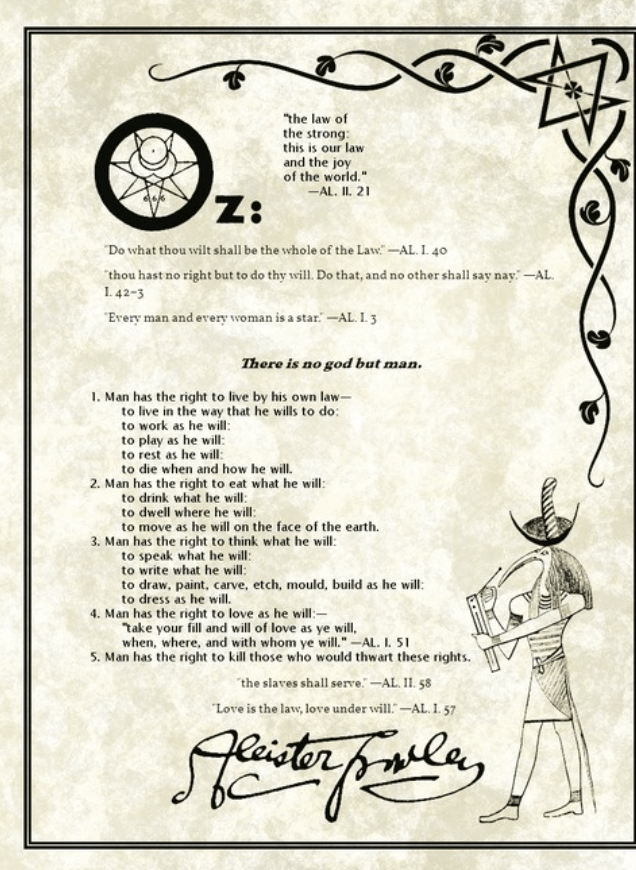
Figure 1. Condensed teachings of AC
Aleister Crowley established a religion based on the teachings of a disincarnate being: Aiwass. On three consecutive days April 8, 9, and 10, 1904, while honeymooning in Cairo, Crowley ‘channelled’ The Book of The Law. Read to-day in the light of intervening world wars and incredible technological changes, the Book of the Law is strikingly accurate. Further, observable compliance among many societal groups which appeared to discourage free thought and deviation from the norm, was something Crowley was passionate about changing.

Figure 2.
Symbol designed by AC used as a meditation device by acolyte’s.
Crowley may be regarded as using self-promotion and psychology to draw a select group and type of follower to his new religion. Many Thelemites, from Thelema meaning will, appeared to have mental health problems and often a drug habit. The Abbey of Themela in Tunisia often had bowls of cocaine and heroin with bottles of quality wine while the food was normally extremely basic and the surroundings understandably grubby.
This seemingly chaotic life-style also taught Magickal practice, with a severe regime. One example, the cutting of the arm with a razor each time one expressed self by saying: I. The purpose of this was to attempt to dissolve the ego, while promoting unity or Gaia hypothesis. Gaia hypothesis promotes the interconnectedness of all beings and refutes separation. Therefor, focus on self, is considered to increase separation.

Figure 3.
Results of focus on self. Crowley style.
Sixties counter-culture embraced Crowley as their spiritual leader. A religion which seemingly promoted drug use and sexual expression of many natures, what was not to like?
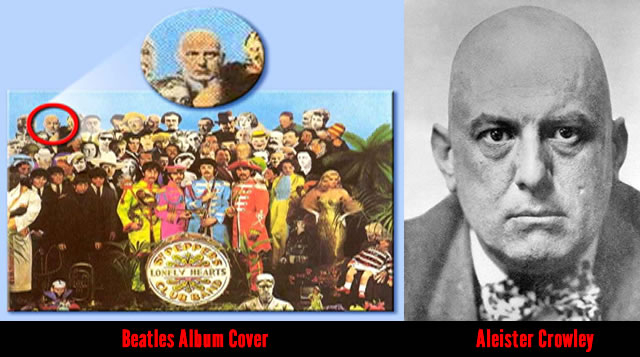
Figure 4. The Beatles endorse Crowley as the Prophet of the New Aeon
However, Crowley’s teachings and the religion of Thelema in fact, did not expressly sanction or promote drug use or unrestricted sexual behaviour. ‘Do What Thou Wilt’, is a clarion call to discover one’s own inner self and act accordingly.
Desmond, McDonagh and O’Donohoe (2000), report on the counter-culture as being a search for knowledge of subconscious. Also, remarking that counter-culture of the 1960’s was more about transcendence, which has morphed into resistance. Thelma teaches of transcendence and resistance, providing tools with which to pry open areas of subconscious igniting a state of greater awareness. Crowley also promoted resistance against governments and rules and regulations which restrict and control. The trust of Thelema’s argument being that transformation in the external world begins with change in the internal world.
The message on how to understand niche markets and the influence a counter culture movement may have, is to understand both the exoteric and esoteric ethos of that movement. The exoteric in the counter-culture / religion model, which occurred in the 1960’s, appeared to be rebellion against previously held values and the installing of progressive values. However, to gain a full understanding of the contributory factors, knowledge of the inner beliefs (the esoteric), such as a matching religious philosophy, offer’s a more complete picture.
To achieve maximum coverage and uptake advertisements require inclusivity. Exclusivity, marginalises groups and shrinks a potential client base. Also, by being mindful of outliers, such as counter-culture groups, marketing will be in place to address the audience when the group becomes mainstream. Heath and Potter (2006), support the claim that counter-culture groups increase consumer culture by creating a new set of goods for rebel consumers.
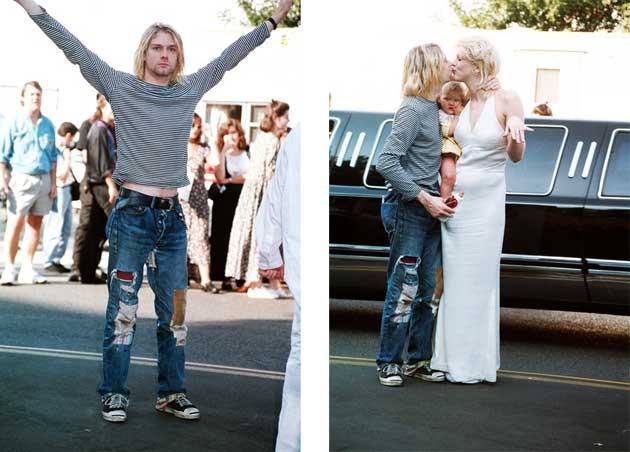
Figure 5.
Grunge goes mainstream.
Carolyn Okomo writing for Chron, gives the example of Calvin Kline and the advert for CK One. Here, one witnesses the interaction between high fashion and the grunge subculture. The advert displays rather gaunt, laid back dudes which drew heavily on the Seattle based grunge culture. Grunge became a world-wide phenomena, quickly becoming a target market for many retailers.
The next predicted market target is the demographic known as the Millennials. Knowledge of how rebellion is ‘played out’ and areas of rebellion given a nod of respect by this group require study and appreciation to tailor adverts correctly.
References
R Desmond, J., Mc Donagh, P., & O’ Donohoe, S. (2000). Counter‐culture and consumer society. Consumption Markets & Culture, 4(3), 241-279. doi: 10.1080/10253866.2000.9670358eferences
Heath, J. and Potter, A. (2006), The Rebel Sell: How the Counter Culture Became Consumer Culture, Chichester: Capstone.
Credits for images.
Accessed 16/11/2018 Image 1 https://i.pinimg.com/736x/42/07/63/4207633a191679c64bc821825e44470c.jpg
Accessed 16/11/2018 Image 2 https://i.pinimg.com/564x/5d/fc/8f/5dfc8f9facc8b274d130827361dae444.jpg (image 2)
Accessed 16/11/2018 Image 3
Accessed 16/11/2018 Image 4
http://revelationnow.net/2013/08/22/they-sold-their-souls-george-harrison/
Accessed 16/11/2018 Image 5

 Religiously Consuming

