
Research suggests that religiosity provides a protective factor against problematic alcohol use (Bazargan et al. 2004; Michalak et al. 2004; Patock-Peckham et al. 1998).
Carl Jung, in a letter to Bill W (Alcoholics Anonymous (AA) co-founder) suggested two ways of leading an individual with alcohol addiction to recovery. The first, real religious insight, and second a protective wall of human community (Kelly et al. 2011), both of which may be presented as an intervention.
AA functions as an intervention, with many adherents finding that alcohol made them ‘spiritually sick’ (Miller, 2007), the 12 – step program enabling the building of spiritual health and also the protective factor of a sober human community with which to relate to.
Step 3, of the 12 – step programme: ‘made a decision to turn our will and lives over to God as we understand him’. Step 5, ‘admitted to God, ourselves and another human being the nature of our wrong doings’, Step 7, ‘Humbly, asked God to remove our short comings’. 12th Step, Step 12, ‘Having had a spiritual awakening as the result of these steps, we tried to carry this message to alcoholics and to practice these principles in all our affairs’.
Although the 12 step programme encourages sobriety by abstinence, members may attend meetings even though inebriated, as relapse is recognised as a part of recovery in some instances. Member are of course encouraged to remain alcohol free, the ‘coin economy’ is offered, this allows relatives and friends to purchase an attractive and inspiring ‘sobriety coin’. This coin, as well as being an attractive memento, serves as a reward and the inscription is inspirational. Key in providing a visible representation, a marker of time (coins are often given monthly) and a reminder of belonging to a protective wall of human community.
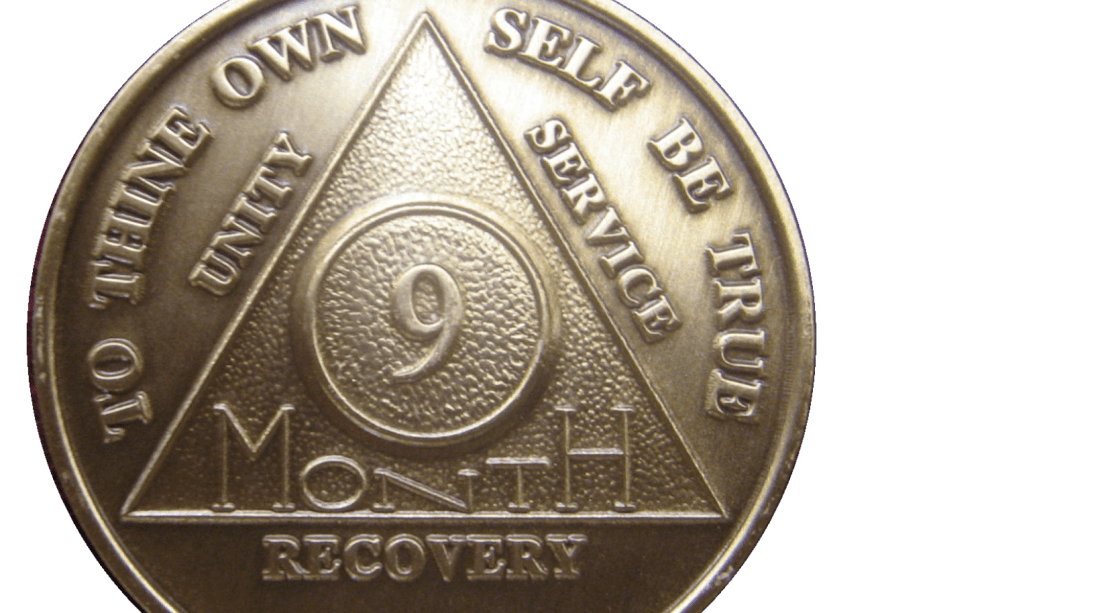
The sobriety coin, as well as offering the above, also connects the member with the AA brand, via the triangle symbol depicted. Often carried as a talisman, a repeated imprinting by continual viewing, the coin affirms membership and stage in the AA program. Wiseman, (2004), conducted research into why carrying a charm mattered, findings suggest that an increase in confidence may be achieved. Individuals requiring control over their environment, when anxious and uncertain about the future are viewed as receiving a greater benefit by carry a charm.
Liebson et al. (1971), researching the token economy and effects on alcohol dependent participants, found that when using the token economy, alcohol consumption came under operant control. In this instance, the participants were all hospitalized because of their condition regarding alcohol. In an institution, the token economy functions very much like money in the greater society outside. Behavior may be shaped, the token acting as a generalized reinforcer, which may be exchanged for many reinforcers. So, in this instance, participants demonstrated an improved control over their alcohol consumption.
In conclusion, religion may offer a protective factor against problematic alcohol consumption. Considering that there is a god (or higher power) appears to aid alcoholics in recovery. The use of sobriety coins, connects the AA member with the in-house community, reinforces continued sobriety and the coin also acts as a talisman, providing confidence.
Word Count: 538
Illustrations Reference list
Figure 1. accessed 26/10/2018: http://www.promisesaustin.com/wp-content/uploads/2015/06/Diverse-group-of-people-in-a-meeting-together-000038471718_Medium.jpg
Figure 2. Figure 2. https://www.woodenurecover.com/assets/images/bronze-aa-month-chips/seven-month-aa-chips.jpg
Figure 3. accessed 26/10/2018: https://www.woodenurecover.com/assets/images/bronze-aa-month-chips/seven-month-aa-chips.jpg

 Religiously Consuming


Check comments are visible
LikeLike